Live stock layout: check window timing, budget readiness, and execution conditions first.
Sponsored
Decision-Support Tool
Track stock windows, copy working codes, and plan high-ROI crop cycles with one player-focused toolkit.
Buy 120 / Sell 380
Buy 550 / Sell 1300
Buy 300 / Sell 760
Data is near real-time with typical delay of 2-10 minutes. Found wrong info? Submit correction.
Sponsored
Live stock layout: check window timing, budget readiness, and execution conditions first.
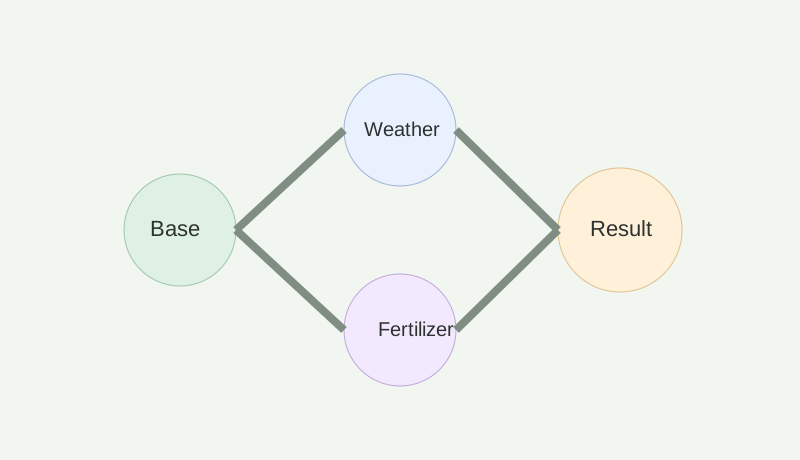
Mutation path model: base crop, weather, and fertilizer must be validated together.
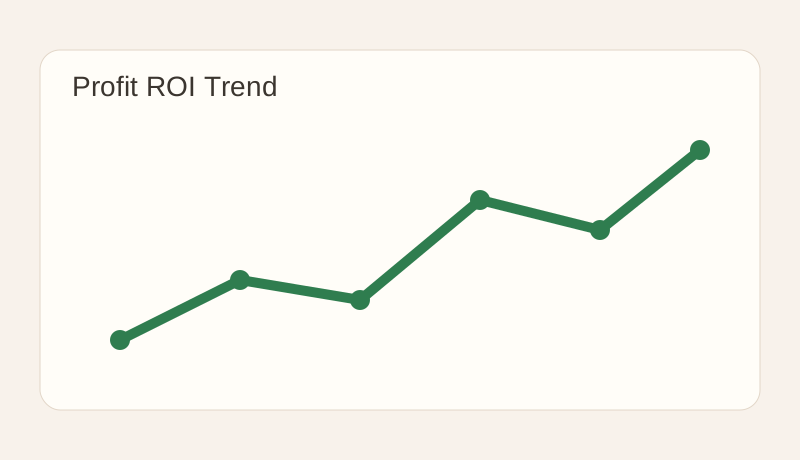
ROI trend view: prioritize stable long-term bands over one-cycle peaks.
500 Coins
Checked: 2026-03-04 17:00 UTC+8
2x Growth Boost (15m)
Checked: 2026-03-04 17:00 UTC+8
Legacy Pack
Checked: 2026-03-03 22:00 UTC+8
Garden Horizons players usually lose coins in two places: buying hype seeds at the wrong time and planting without a repeatable profit model. GH.Tools focuses on these decisions with four linked workflows: stock timing, mutation planning, ROI estimation, and code redemption. Instead of reading long wiki pages and manually comparing values, you can move from data to action in one session.
Step 1: open the live stock section and identify whether current offers fit your coin reserve. If you are underfunded, do not force a legendary purchase. Step 2: run candidate crops through the ROI calculatorand compare stable coins-per-minute rather than best-case outcomes. Step 3: for advanced profit, open mutation pagesand verify weather and fertilizer prerequisites before spending. Step 4: apply currently working codes to reduce early-cycle risk.
The process aligns decision timing with opportunity windows. Stock timing protects your entry cost. ROI filtering removes emotional overbuying. Mutation checks reduce failed attempts caused by missing conditions. Combined, this gives a repeatable strategy for beginner and mid-level progression, especially when you have limited plots and limited session time.
New players should start with Guides, then use stock history to estimate likely reappearance intervals. Advanced players can jump directly to specific mutation pages such as Dawn Fruit and Golden Bamboo. If any data looks stale, report it on the contact page.
Based on recent correction reports and play sessions, the most stable progression loop remains: maintain one low-risk cashflow lane, one mutation lane, and only enter high-volatility seeds when your reserve can cover at least one failed cycle. For most accounts, this outperforms all-in legendary buying and reduces reset frustration. We keep updating this recommendation as new reports arrive.
Sponsored
Many players treat rare stock as an automatic buy signal in early progression, but long-term returns usually depend on process quality, not one lucky cycle. The real gap between average and advanced players is repeatability: can you run the same decision loop, verify assumptions, and improve after each harvest window.
The stock window should be the first gate in your workflow. It is not enough to see a countdown. You should combine freshness timestamp, 24-hour appearance frequency, and your current budget before entering. A purchase is strategically valid only when all three align with your execution capacity.
The second core principle is cashflow architecture. New players often overcommit to high-volatility seeds and lose two or three cycles when weather or mutation conditions do not match. Keep at least one stable crop lane active at all times. It may not have the highest peak return, but it protects growth continuity.
The third principle is mutation execution discipline. Guides often list weather and fertilizer requirements without explaining sequence cost. In practice, preparing inputs before the window opens produces better outcomes than last-minute procurement under time pressure.
The fourth principle is structured review. After each cycle, record buy cost, actual sell value, occupied time, and whether conditions triggered as expected. Within one week of logging, most players discover that their personal best route differs from generic tier lists.
Efficiency-focused players should run a dual strategy model: one baseline route for stable periods and one tactical route for event windows. When events appear, swap tactical parameters rather than rebuilding your whole plan. This keeps momentum and reduces operational error.
Community consensus matters because single-source signals can include delay or noise. We prioritize reproducible, timestamped, cross-verifiable reports. Strategy lines displayed on GH.Tools are intended to be actionable summaries of validated observations, not generic motivational text.
The goal is not to hit the highest possible seed every time. The goal is to sustain growth across variable conditions with consistent decision quality. When stock timing, budget discipline, mutation execution, and review feedback are combined, account progression becomes more predictable and scalable.
To meet long-term content quality expectations, each page should answer real user problems, not just list keywords. We use a structure of context, method, risk, and action so readers leave with clear next steps.
E-E-A-T is not about volume alone; it is about verifiability. Every recommendation should include assumptions, valid scenarios, and failure boundaries. Readers trust content more when limitations are explicit.
For game utility sites, practical experience signals come from review cycles. Session logs, adjustment notes, and variance audits provide stronger authenticity than generic claims.
Layout should support decision speed. Dense content is easier to consume when split into sections with clear headings, key blocks, and guided internal links. This is especially important on mobile.
From a search perspective, longform pages should cover intent space: what it is, when to use it, how to use it, why it works, and when it fails. This naturally captures broader query coverage.
Internal links should form a task loop. Readers should be able to move from explanation to calculator, from calculator to mutation detail, and from mutation back to stock execution in one flow.
Compliance pages are not box-checking artifacts. Privacy, terms, about, and contact pages indicate maintenance maturity and accountability, which directly affects trust and branded search behavior.
The end goal is page-level independence. A user who lands on any single page from search should still get full context, method, and next-step navigation without needing to restart from the homepage.